
Why You Feel Overwhelmed at Work
Discover why unfinished work creates stress, how decision fatigue affects productivity, and practical ways to reduce mental overload while improving execution.
What you'll learn
By the end of this article, you'll understand:
- Why unfinished work feels mentally exhausting
- How the Zeigarnik Effect keeps tasks in your mind
- Why motivation isn't the real problem
- How decision fatigue affects execution
- Three practical ways to reduce mental overload
You closed your laptop.
But your work never left your mind.
If that sounds familiar, you're not alone.
Most people think stress comes from having too much work.
The truth is often more subtle.
Stress isn't created by your workload. It's created by the weight of unfinished work.
Every unfinished promise asks your brain to remember one more thing.
Eventually, your mind stops feeling like a place for ideas.
It starts feeling like a storage room.
The email you never replied to.
The project you've postponed for weeks.
The doctor appointment you keep delaying.
The idea you were excited about but never started.
The friend you promised to call back.
Individually, these seem small.
Together, they quietly occupy your attention all day.
Psychologists sometimes describe this tendency as the Zeigarnik Effect—our minds naturally keep returning to unfinished tasks more than completed ones. While this can help us remember important work, it can also contribute to mental clutter when too many open loops accumulate.
Your Brain Keeps Too Many Tabs Open
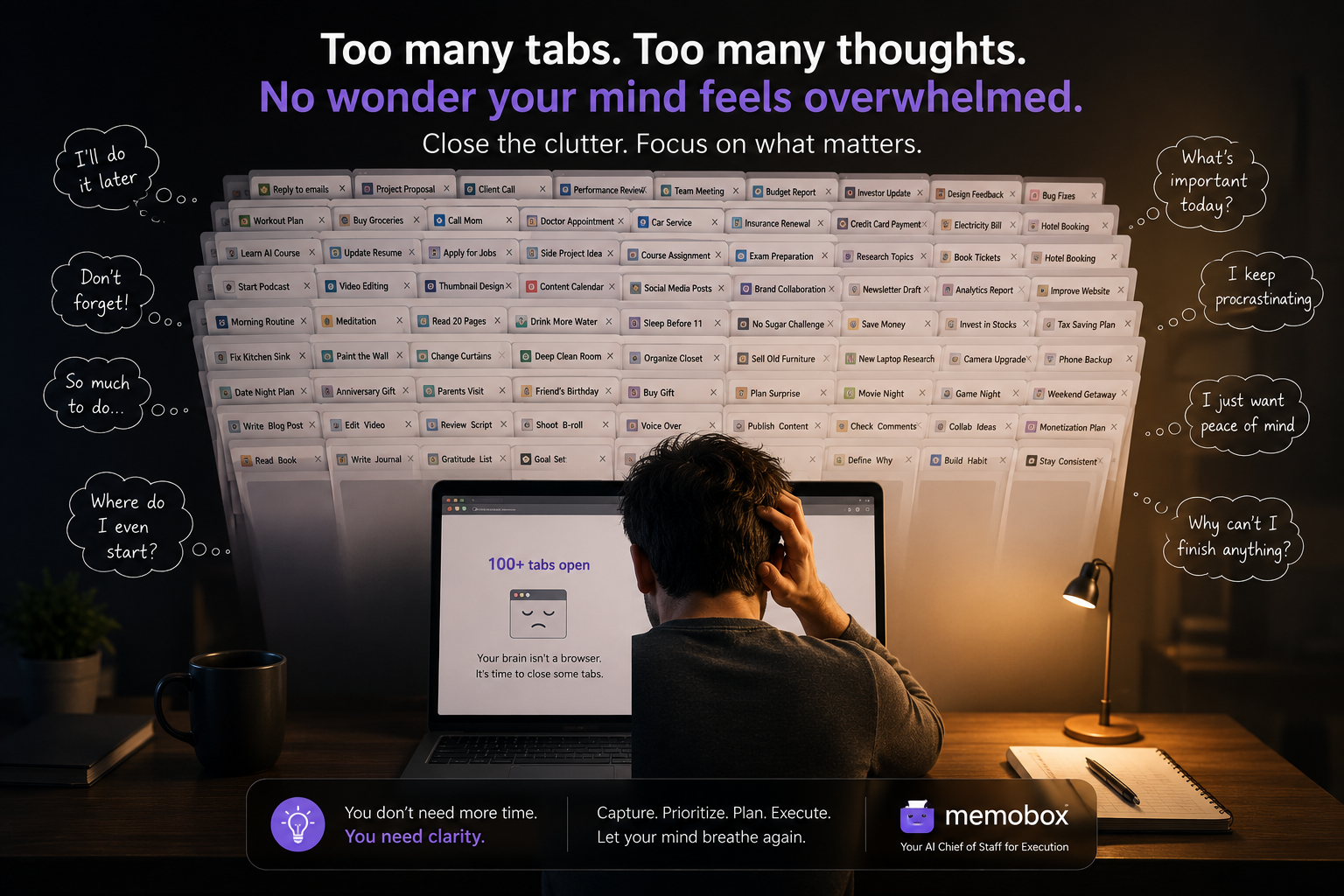
Every unfinished promise becomes another open tab in your mind.
The result?
You wake up tired.
You feel guilty before opening your laptop.
You finish your day wondering why you worked so hard but still feel behind.
This isn't laziness.
And it isn't a lack of ambition.
It's mental overload.
Your brain isn't overwhelmed because you have too much work. It's overwhelmed because it doesn't trust that the work will be remembered.
Why Motivation Doesn't Solve the Problem
One of the biggest myths in productivity is that motivated people achieve more.
They don't.
Motivation comes and goes.
Some mornings you feel unstoppable.
Other mornings you struggle to answer a simple email.
If your entire system depends on motivation, your progress becomes unpredictable.
The people who consistently achieve meaningful goals usually rely on something else.
A system.
The Hidden Cost of Too Many Decisions
Every day your brain answers hundreds of questions.
What should I do first?
Which email is urgent?
Should I attend this meeting?
Can this wait until tomorrow?
Do I have enough time?
By noon, you've often spent more energy deciding what to do than actually doing it.
Researchers call this decision fatigue.
The more decisions you make, the harder it becomes to make good ones later in the day.
That is one reason why many professionals end up avoiding the work that matters most.
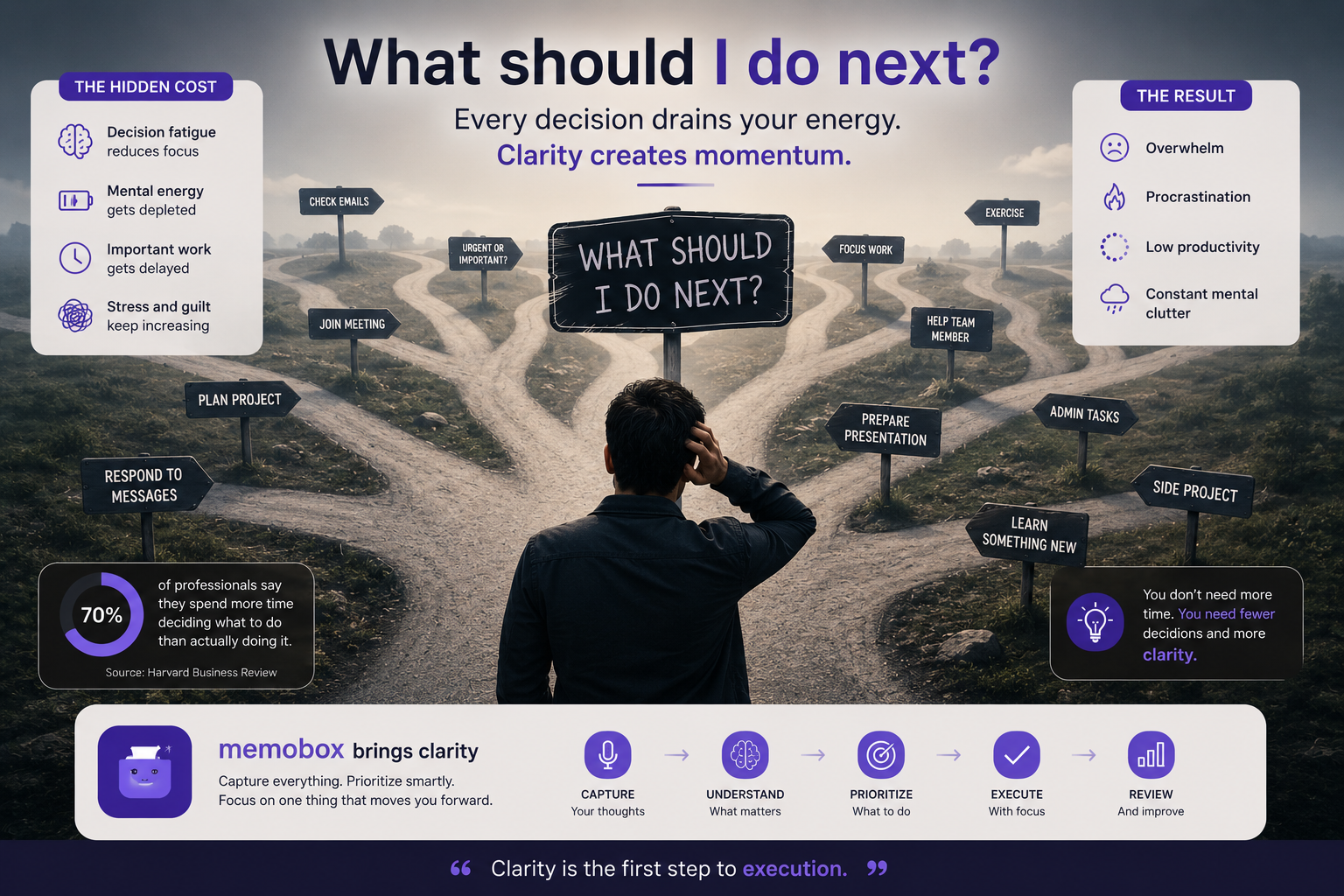
Every small decision steals energy from the work that actually matters.
Why Most Productivity Apps Don't Fix This
Traditional task managers are excellent at storing information.
But your brain isn't overwhelmed because it lacks storage.
It's overwhelmed because it lacks clarity.
Long task lists can actually increase anxiety.
Seeing fifty unfinished items every morning doesn't reduce stress.
It reminds you of everything you're not doing.
Productivity isn't remembering more. It's remembering less because your system remembers for you.
The Difference Between Organizing and Executing
Organizing answers:
"What do I need to do?"
Execution answers:
"What should I do right now?"
That difference changes everything.
Execution means:
- Capturing ideas before they're forgotten
- Understanding what actually requires action
- Prioritizing intelligently
- Planning your day realistically
- Breaking complex work into smaller steps
- Following through until it's finished
- Reflecting and improving over time
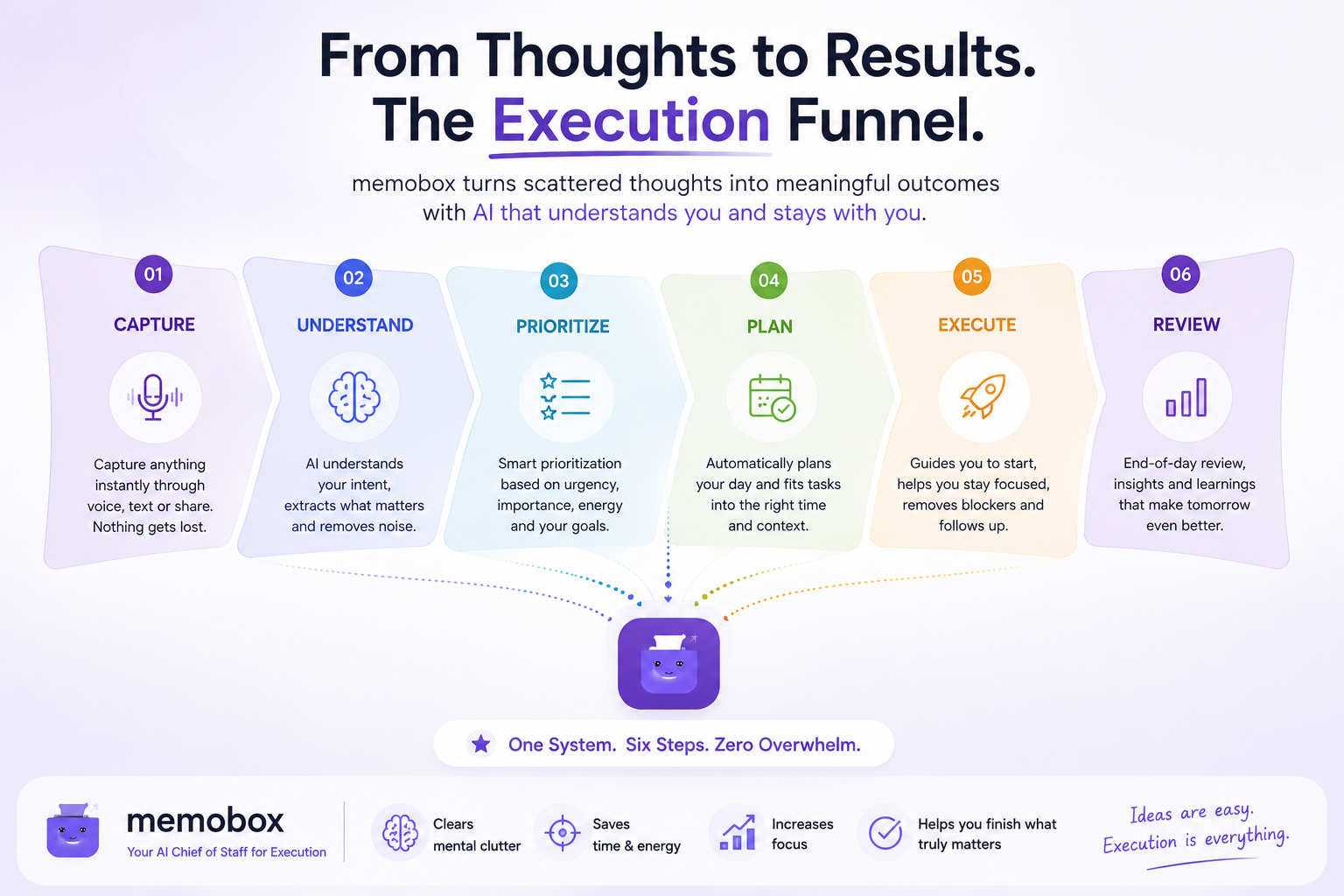
Execution isn't one action. It's a system. Capture → Understand → Prioritize → Plan → Execute → Review.
How to Reduce Mental Overload
You don't need another complicated productivity framework.
Start with a few habits.
1. Stop carrying everything in your head
Write it down.
Record it.
Capture it immediately.
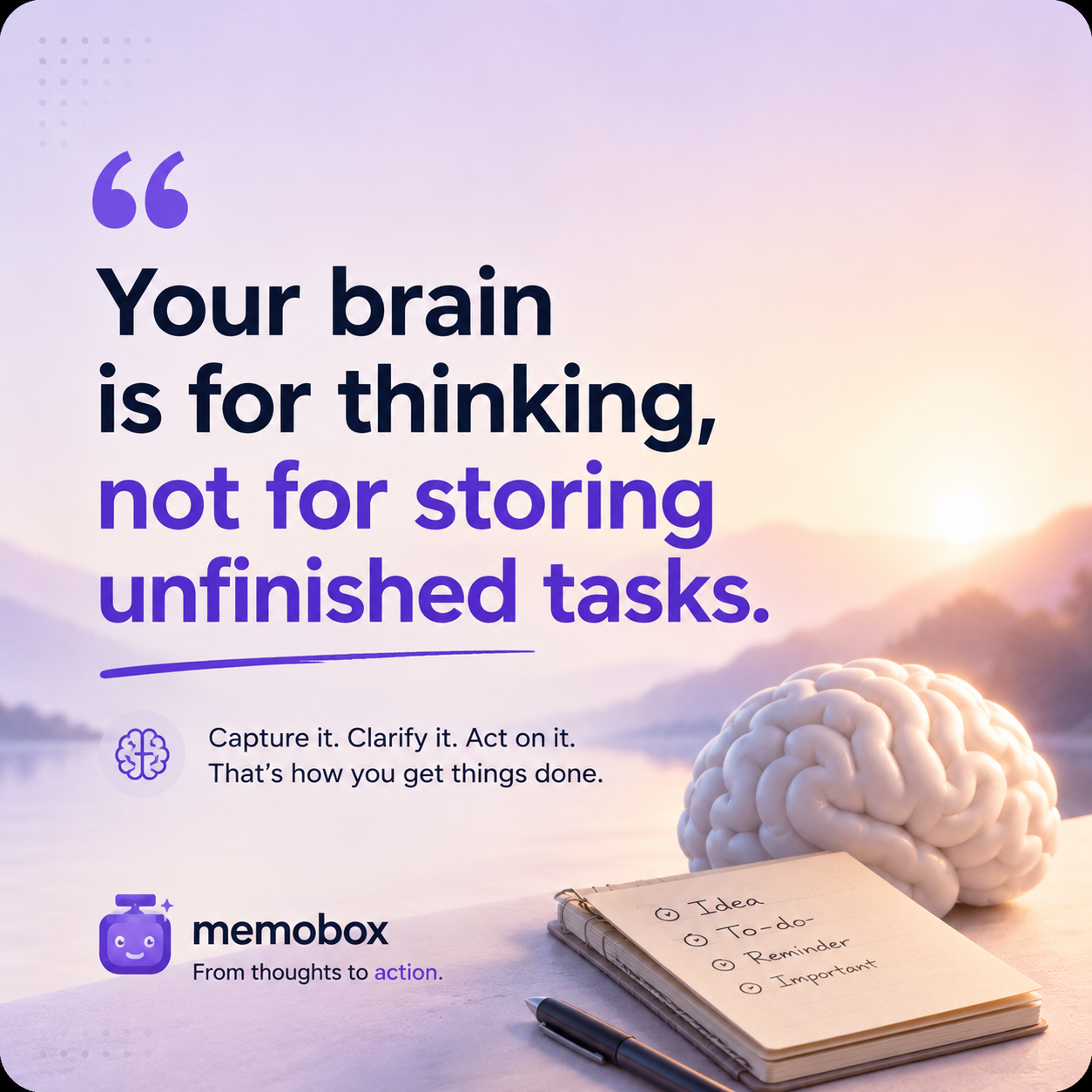
Your brain is designed for thinking—not long-term storage.
2. Decide on one priority
Trying to make progress on ten important tasks usually means finishing none of them.
One meaningful accomplishment often creates more momentum than ten half-finished ones.
3. Review your day
Spend five minutes asking yourself:
- What did I complete?
- What blocked me?
- What deserves tomorrow's attention?
Small reviews prevent small problems from becoming overwhelming.
The Question We Couldn't Ignore
As we explored these patterns, one question kept coming back.
If the human brain wasn't designed to remember everything...
Why do our productivity tools still expect it to?
That question eventually became the foundation for Memobox.
Not another place to store a longer list.
But a system that could remember what matters.
Help clarify what deserves attention.
Reduce unnecessary decisions.
Make starting easier.
And gently bring you back when life becomes busy again.
An AI companion designed to help people move from intention to execution.
Technology shouldn't exist to create more notifications.
It should create more clarity.
It shouldn't ask you to remember another task.
It should help you finish the ones that matter.
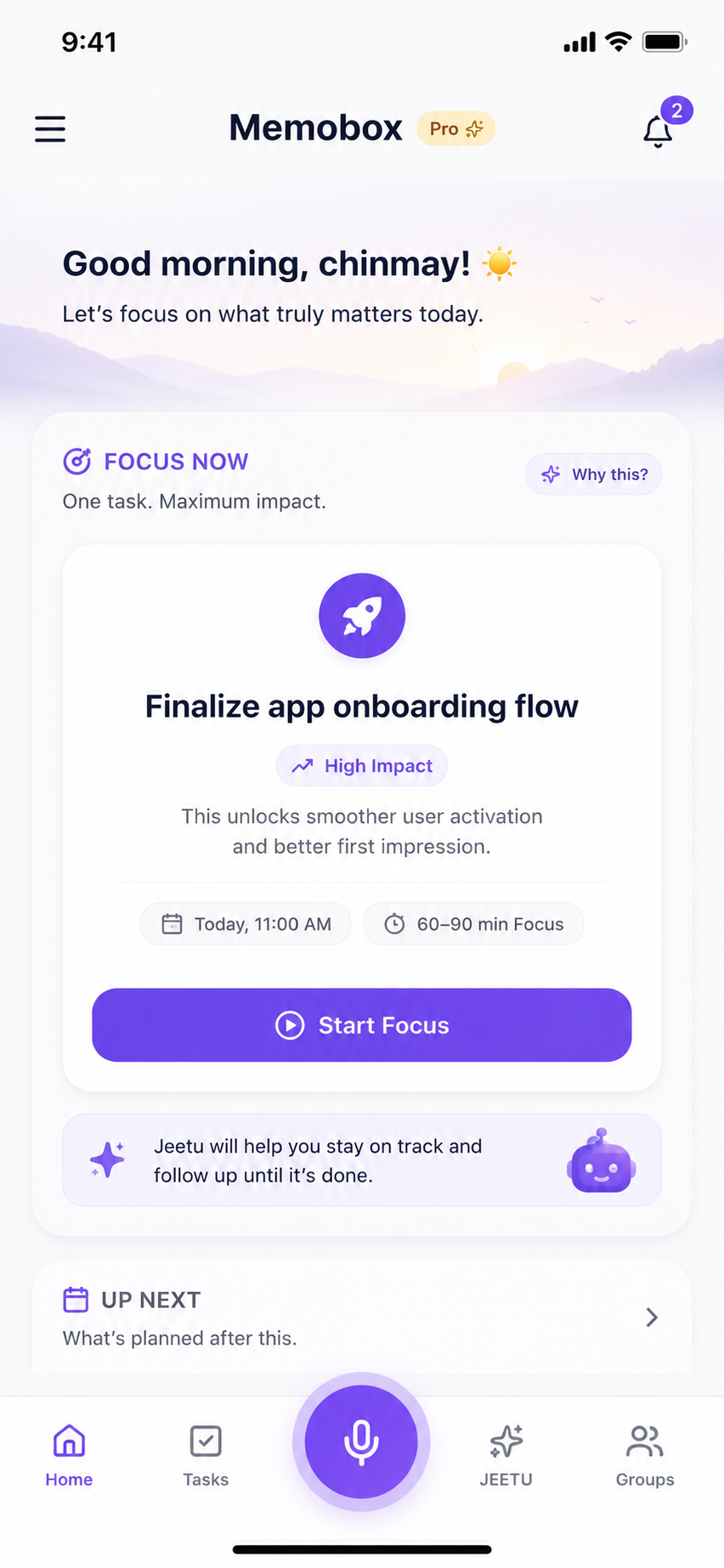
Instead of showing everything you could do, Memobox helps you focus on the one thing that matters now.
Final Thoughts
Your brain isn't asking you to work harder.
It's asking you to carry less.
Capture what matters.
Trust your system.
Focus on one meaningful step.
Because in the end, our lives aren't defined by the plans we make.
They're defined by the work we finish.
Ideas are easy. Execution is everything.
Behind the Science
This article introduces several established ideas from psychology and behavioral science. We've simplified them to focus on practical application rather than academic detail.
- Zeigarnik Effect
- Decision Fatigue
- Cognitive Load
- Attention Residue
Reflection
What's one unfinished task that's been quietly occupying your mind?
You don't have to finish it today. Write it down. Then give yourself permission to stop carrying it.
Execution Exercise
5 minutesWrite down every unfinished task currently occupying your mind.
- Don't organize them.
- Don't prioritize them.
- Just capture them.
Which one deserves my attention first?
That's your Focus Now.
Why does your brain keep replaying unfinished work even after you've left the office?
We'll answer that next.
Why Your Brain Never Stops Thinking About WorkContinue your journey
Lesson 01 of 7 · Memobox Academy
- Lesson 02Why Your Brain Never Stops Thinking About Work
- Lesson 03The Science of Open Loops
- Lesson 04Decision Fatigue Explained
Let Memobox carry what your mind shouldn't.
Capture what matters, create clarity, and focus on the next meaningful step.
Download Memobox on Google Play